Read the major security frameworks side by side and the access-control sections say remarkably similar things in different words. Give people only the access their role needs. Approve it before it is granted. Give privileged access extra care. Remove it when it is no longer needed. Review it periodically. And keep records that prove all of this happened. What differs is the vocabulary, the level of detail, and how hard the auditor or regulator will look.
This post reads SOC 2, ISO/IEC 27001:2022, PCI DSS 4.0, the EU’s NIS2 Directive and the Digital Operational Resilience Act (DORA) for what they ask of privileged access, then sets out the records an access programme must be able to produce. It is a guide for boards and senior management, not legal advice. Control numbering and wording below are summarised; confirm the exact text and its interpretation for your organisation with your auditor or adviser.
In short
- Five expectations recur everywhere: least privilege, approval before access, special care for privileged access, timely removal, and periodic review.
- Evidence is the test. Auditors sample access changes and ask for the request, the approval, the grant and the removal. A policy without records fails.
- The bar is rising. PCI DSS 4.0 tightened review and authentication requirements; NIS2 and DORA put access control in law and make management bodies accountable.
- Standing privilege is the hardest thing to defend. Time-limited, approved, recorded access answers most of these questions by construction.
- Confirm the wording with your auditor. This is a summary for planning, not a substitute for the standards themselves.
The five expectations every framework shares
Before looking at each framework, it helps to see the common core. Across all five, an auditor or supervisor is looking for evidence of the same five properties, applied with particular rigour to privileged access — administrator rights, database owners, cluster-wide roles, and anything that can change other people’s access.
| Expectation | In plain words | What the auditor asks for |
|---|---|---|
| Least privilege | People get the access their job needs and no more | Role or entitlement definitions; evidence that grants match them |
| Authorisation | Access is approved by someone accountable before it is granted | A sample of grants, each with a recorded approval by an appropriate person |
| Privileged access managed | Powerful rights are restricted, justified, time-bound and monitored | The list of privileged users, the reason for each, and how use is monitored |
| Timely removal | Access ends when it is no longer needed | A sample of leavers and movers, and evidence of removal within policy |
| Periodic review | Someone accountable re-confirms access at a set interval | Completed reviews, who reviewed, what was removed as a result |
SOC 2: the Common Criteria for logical access
SOC 2 reports are built on the AICPA’s Trust Services Criteria. Access control sits mainly in the CC6 series, “logical and physical access controls”. Three criteria do most of the work for privileged access:
- CC6.1 — the entity implements logical access security over protected information assets, including restricting access and managing credentials and privileged access.
- CC6.2 — before issuing credentials and granting access, the entity registers and authorises users, and removes access when it is no longer authorised.
- CC6.3 — the entity authorises, modifies or removes access based on roles and responsibilities, considering least privilege and segregation of duties.
SOC 2 does not prescribe a review interval or a technology. The auditor tests whether your own described controls operated across the period, typically by sampling. For a Type 2 report, that means a sample of access grants with their approvals, a sample of removals, and evidence that reviews took place as your policy says. Monitoring criteria in the CC7 series are often tested alongside, for how anomalous activity is detected.
ISO/IEC 27001:2022: Annex A controls
The 2022 revision reorganised Annex A into four themes. The access controls an auditor will read against a privileged access programme are chiefly:
| Annex A control | Subject | What it expects, in summary |
|---|---|---|
| 5.15 | Access control | Rules to control access to information and assets, based on business and security requirements |
| 5.16 | Identity management | The full life cycle of identities is managed |
| 5.18 | Access rights | Access rights are provisioned, reviewed, modified and removed in line with policy and rules |
| 8.2 | Privileged access rights | Allocation and use of privileged access rights is restricted and managed |
| 8.5 | Secure authentication | Authentication technologies and procedures appropriate to the access |
| 8.15 | Logging | Logs that record activities and other relevant events are produced, kept and reviewed |
The guidance in ISO/IEC 27002:2022 for control 8.2 is direct about the behaviours an auditor will look for: an authorisation process for privileged rights, allocation on a need-to-use and event-by-event basis, expiry requirements, and logging of privileged use. Time-limited, per-task access is close to a literal reading of that guidance. As always, the certification auditor tests against your Statement of Applicability and your own policies.
PCI DSS 4.0: requirements 7 and 8
The Payment Card Industry Data Security Standard is the most prescriptive of the five. Version 4.0 (with its 4.0.1 update) has been the only active version since the end of 2024, and requirements that were “future-dated” became mandatory from 31 March 2025.
| Requirement | Subject, summarised | Why it matters for privileged access |
|---|---|---|
| 7.2.1 – 7.2.3 | An access control model; access assigned on job classification and least privilege; approval by authorised personnel | Every grant to the cardholder data environment needs a defined basis and an approval |
| 7.2.4 | All user accounts and their access privileges reviewed at least once every six months, with management acknowledging the result | A recurring, documented review — not just for leavers |
| 7.2.5 – 7.2.5.1 | System and application accounts limited to least privilege, and their access reviewed periodically | Service and CI roles, not only people, are in scope |
| 8.2.6 | Inactive user accounts removed or disabled within 90 days | Standing accounts nobody uses are a finding in their own right |
| 8.4.2 | Multi-factor authentication for all access into the cardholder data environment | Step-up at the moment of privileged access supports this |
| 10.2 | Audit logs capture user activities, including all actions by anyone with administrative access | The trail must show what privileged users did, not only that access existed |
A practical reading for a payments business: every administrator in the cardholder data environment is a line in a six-monthly review, every grant needs an approval, and every action under administrative access must be logged. The fewer standing administrators there are, the shorter and more defensible each of those becomes.
NIS2 and DORA: access control in law
The two EU instruments differ from the standards above in one important way: they are law, and they make management accountable. NIS2 (Directive (EU) 2022/2555) applies to essential and important entities across many sectors. DORA (Regulation (EU) 2022/2554) applies to financial entities and has applied since 17 January 2025.
| Instrument | Where access appears | What it expects, in summary |
|---|---|---|
| NIS2, Article 21(2) | Points (i) and (j) of the list of risk-management measures | Human resources security, access control policies and asset management; and the use of multi-factor or continuous authentication where appropriate |
| NIS2, Article 20 | Governance | Management bodies approve the cybersecurity risk-management measures, oversee their implementation and can be held liable |
| NIS2 implementing rules | Commission Implementing Regulation (EU) 2024/2690, for certain digital-infrastructure and digital-provider entities | More detailed requirements, including for privileged and system administration accounts and access review |
| DORA, Article 9 | Protection and prevention | Policies that limit physical and logical access to ICT assets to what is required for legitimate and approved functions, and strong authentication |
| DORA RTS on the ICT risk-management framework | Commission Delegated Regulation (EU) 2024/1774, access-control provisions | Least privilege and need-to-know, management of privileged accounts, timely revocation and periodic review of access rights, with logging |
Confirm the wording
The summaries in this post are deliberately short. Article and requirement numbers are given so you can find the source text, but interpretation varies by entity, sector and national transposition (NIS2 is a directive, implemented in each member state’s law). Confirm the exact wording and what your auditor or supervisor expects before mapping controls.
The records you need to be able to produce
Every one of these frameworks ultimately asks to see records. The practical test of an access programme is whether, for any privileged grant in the audit period, it can produce the full story without anyone reconstructing it from chat history and cloud logs.
who, what, why, ticket"] --> S["Scope
permission narrowed"] S --> K["Risk score
every factor shown"] K --> A["Decision
auto or named approver
step-up if required"] A --> G["Grant
what the broker created"] G --> W["Session
activity and flags"] W --> X["Removal
expiry or early revoke"] X --> V["Review
keep or remove, by whom"] V --> E["Evidence export
to compliance tooling"]
One record per grant, from request to review. An auditor sampling any grant should be able to follow it end to end.
| Record | What it should contain | Frameworks it supports |
|---|---|---|
| Request | Requester, resource, access level, duration, ticket, reason in their words | SOC 2 CC6.2; ISO 5.18; PCI 7.2 |
| Decision | Who approved or that it was approved automatically by which rule; the risk score and why; second factor if used | SOC 2 CC6.2–CC6.3; ISO 8.2; PCI 7.2.3, 8.4.2 |
| Grant | The exact permission created, where, and its expiry | SOC 2 CC6.1; ISO 8.2; DORA access-control RTS |
| Activity | What was done under the grant, with anything out of scope flagged | SOC 2 CC7; ISO 8.15; PCI 10.2 |
| Removal | When and how access ended, and by whom or what | SOC 2 CC6.2; ISO 5.18; PCI 8.2.6 |
| Review | Each line kept or removed, reviewer, date, reason | ISO 5.18; PCI 7.2.4; NIS2 and DORA review expectations |
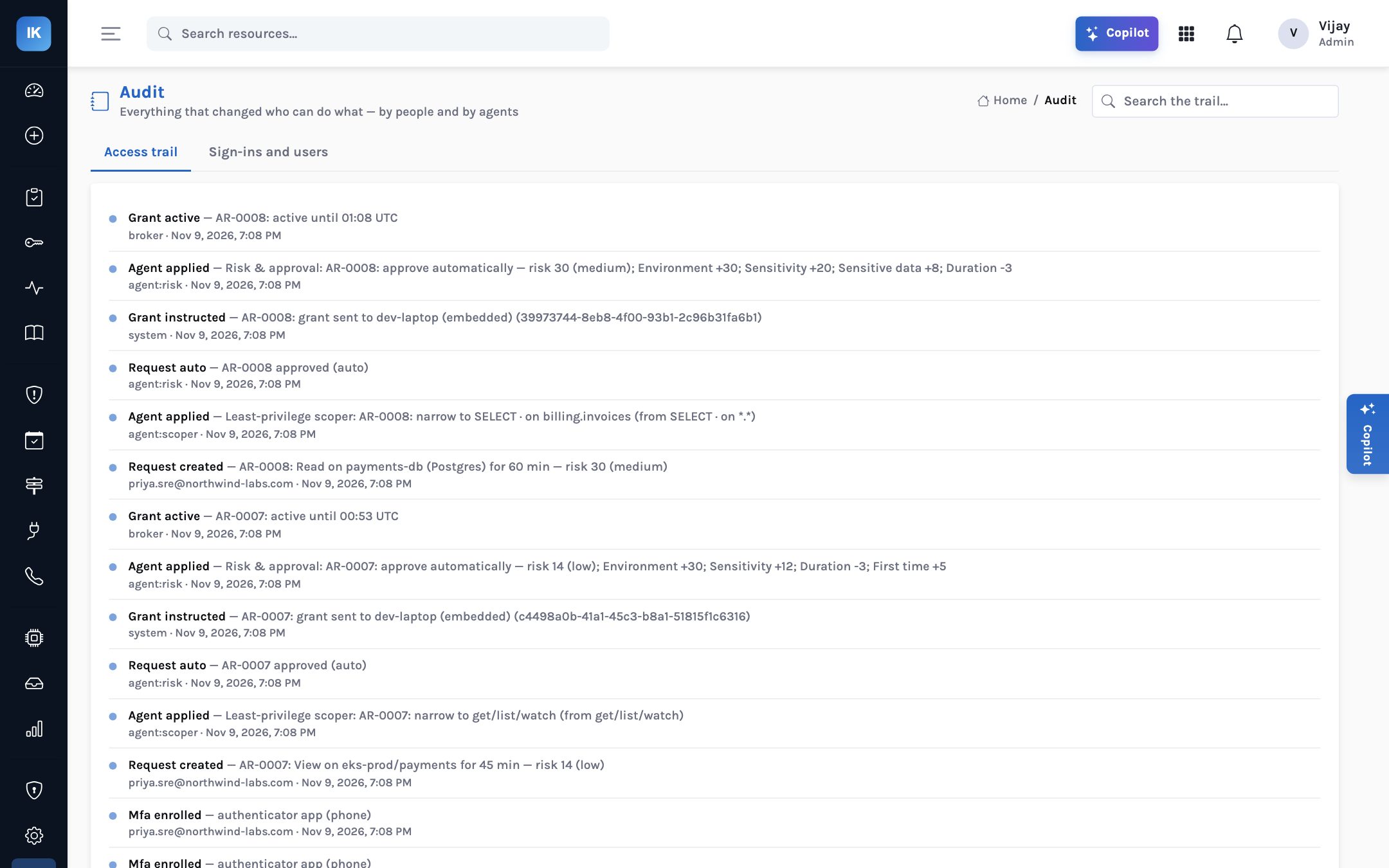
InsightKeys keeps that record by default. The audit trail describes in words every request, approval, grant, revocation, instruction to the broker and agent action. Grants and access reviews can be exported to InsightAssure, VerticalServe’s compliance product, as evidence for access-control controls, and reviews can be exported as CSV for any other tool.
Periodic review that a reviewer can actually do
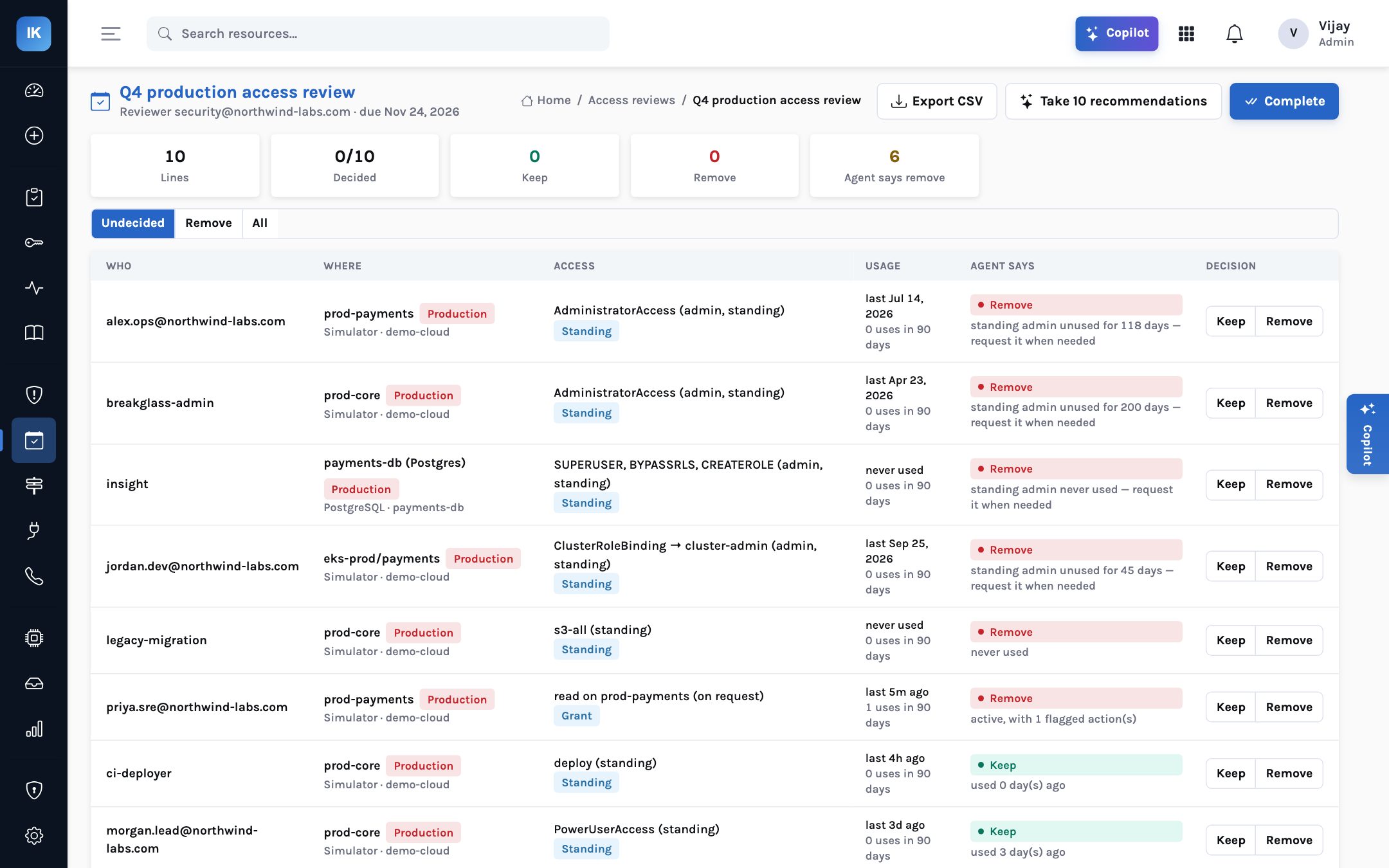
Access reviews are where many audit findings start, and where many organisations quietly fail. A spreadsheet of hundreds of lines with no usage data cannot be reviewed meaningfully, so it is approved wholesale, and the review becomes evidence of a process rather than of a decision. PCI DSS 7.2.4’s requirement for management to acknowledge that access remains appropriate is hard to meet honestly that way.
A review becomes credible when each line carries evidence. In InsightKeys, review campaigns are created per scope — for example, all production access, standing plus grants from the last ninety days. Each line is pre-filled with last use, number of uses in ninety days, and an agent recommendation to keep or remove with its reason. The reviewer still decides. Removing a line sends the revocation through the broker, so the review and the removal are one record.
What the board should ask
For the CISO
Can we produce, for any privileged grant in the last year, the request, approval, grant, activity and removal, without reconstruction?
Which frameworks apply to us, and has our auditor confirmed our mapping of access controls to each?
For the platform lead
How many standing administrators remain per regulated system, and what is the plan for each?
Is every grant to a regulated system time-limited, and does it expire even if a tool is down?
For the board
Under NIS2 and DORA, management bodies approve and oversee these measures. Ask for a short quarterly report: standing privileged access left, reviews completed on time, exceptions open.
Ask what the last access review actually removed. A review that removes nothing is a warning sign, not a success.
What a tool can and cannot do for compliance
No product makes an organisation compliant. InsightKeys produces records that support access-control controls; your auditor decides whether those records, together with your policies and other controls, meet the requirement. It also only records access it grants: systems outside its 1.0 integrations (AWS IAM Identity Center, AWS IAM, PostgreSQL, Kubernetes) need their own evidence.
Every framework asks the same question in different words: who had powerful access, why, approved by whom, for how long, and what did they do?
Design the access programme so that the answer is a record, not a reconstruction — then confirm with your auditor that the record says what they need.